
Copyright protected
Overview
Tag Series consists of 3 different events:

Open Series
The Open Series is a social club-based competition with a global ranking. Teams play against each other within their own competition in their chosen division over a 4-week period with 2, 25-minute games being played each night. Twelve series are conducted each year, with Clubs from around the World competing. An Open Series World Champion will be crowned in each division each year.

Pro Series
Pro Series events are targeted towards teams looking to qualify for the World Series. Teams from the Open Series who qualify can compete in a Pro Series event. Pro Series events are typically run over 1 day with 8 teams per division competing to improve their World Championship qualifying points.

World Championship
The World Championships event hosts the best teams worldwide. It is held annually with teams vying to be crowned the World Champion for each division. Teams and players must compete in the required number of Open Series to be eligible. The top teams from the Pro Series qualify for the World Championships.
Chapter 1: Game Basics
Playing Field
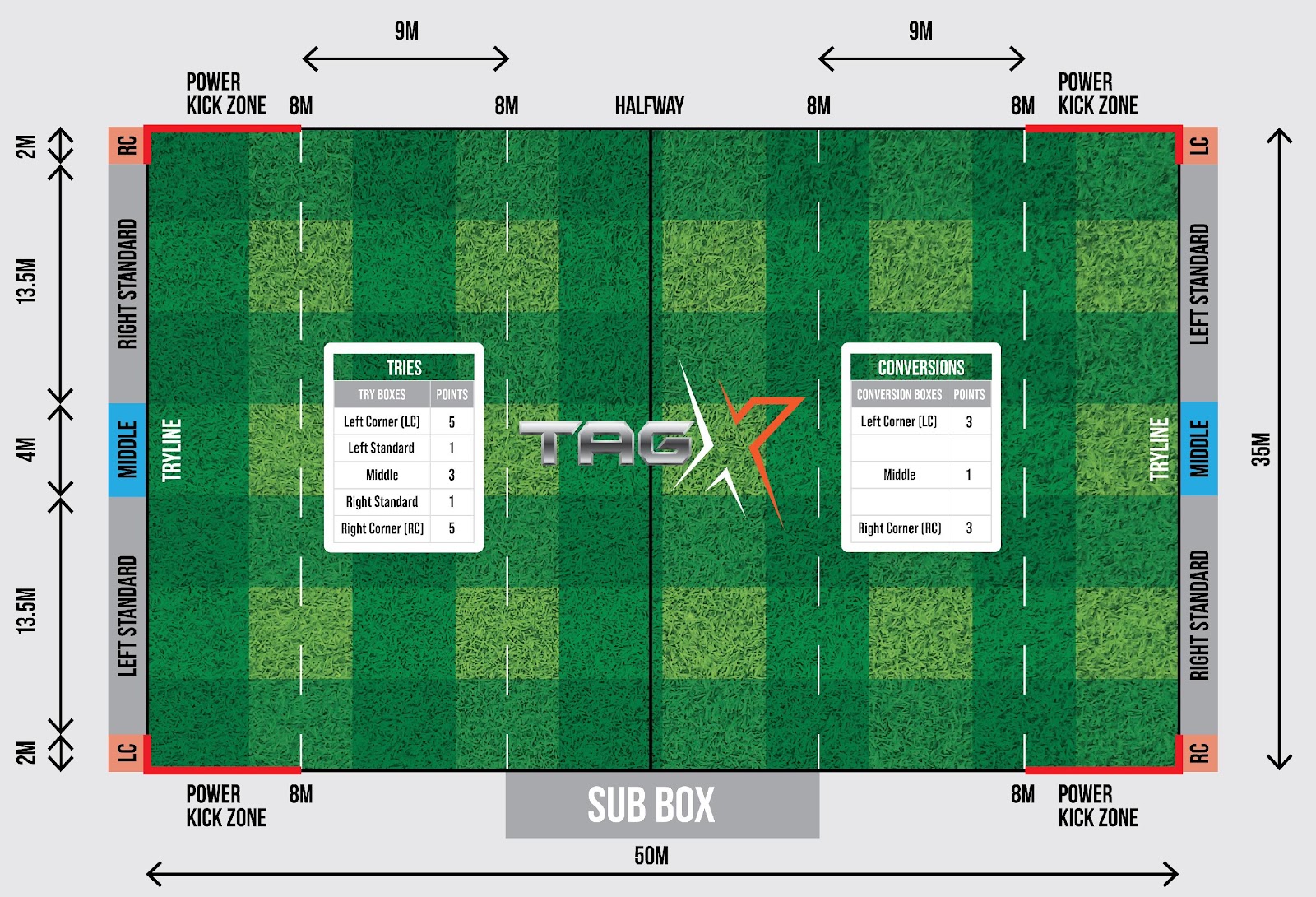
A Tag Series field is 35m wide x 50m long. Figure 1 identifies how a field should be set out.
- If obstructions such as fences or goal posts are present, then fields can be reduced to no less than 33m in width and 48m in length.
There are halfway and 8m lines (8m from halfway line and 8m from the try line) identified on the field.
There are 5 try scoring boxes:
- 2 x standard boxes – between the middle and corner boxes.
- 1 x middle box – centre of the try lines, 4m wide.
- 2 x corner boxes – left and right corners of the field, 2m wide.
There are 3 conversion boxes:
- 1 x middle box – centre of the try lines, 4m wide.
- 2 x corner boxes – left and right corners of the field, 2m wide.
From the dimensions below it can be identified that four fields would fit on any normal size rugby or soccer field.
Figure 1: Field set-up
Playing Equipment
- Each team shall use a maximum of 7 pairs of tags. If a player is substituted the player leaving the field shall hand the tags to the replacement player.
- The tags to be used are Official Tag Series sanctioned tags.
- Player’s normal clothing shall consist of a numbered shirt of distinctive colors and/or patterns, a pair of sanctioned Tag shorts/tights or Tag Series belts, molded plastic studded boots (no screw in or metal studs) or joggers.
- If belts are used pocketed shorts cannot be worn.
- If belts are worn too high on the waist or swivel out of position (so that the tags are not sitting on the side of the player), the referee will call tag when a defensive player comes within tagging distance. Belts worn too high is at the referee’s discretion.
- If shorts are worn too low the referee will call tag when a defensive player comes within tagging distance. Shorts worn too low is at the referee’s discretion.
- This may include if shorts are pulled low by a defensive player attempting to make a tag.
- Players shall not wear anything that might prove dangerous to themselves or other players. This includes (but not limited to):
- Watches, bracelets, wrist bands, large earrings, and necklaces.
- Loose fitting clothing.
- Sunglasses. Prescription glasses are permitted.
- Any items that cannot be removed must be securely taped over.
- Smart Watches are able to be used for tracking purposes if sufficiently taped over.
- The referee and/or Tag Series official can inspect player’s equipment prior to the commencement of a game. The referee and/or Tag Series official can request a player to remove any equipment that s/he considers dangerous and prevent that player from participating in the game if s/he does not comply with the request.
Players and Teams
- A team can have between 8 and 10 players in total. The number of players on the field differs for attack and defence:
- Attack – 7 players on the field at a time.
- Defence – 6 players on the field at a time.
- This includes when a team is executing a kick-off or drop-out as they will become the defensive team.
- In co-ed divisions:
- There can only be a maximum of 6 male players registered to a team for a series.
- There is a maximum of 4 male players on the field to start the 1st and 2nd half.
- There is a maximum of 5 male players in defence once a half has started.
Note: Mixed teams are able to play if no females are present (i.e. with 6 men) however the above rules must be observed with reference to the number of men on the field permitted.
- The game shall be played by two teams each consisting of at least 5 players per side.
- If a team or teams cannot field 5 players in attack to start the game, then they will forfeit.
- Any number of replacements per team is allowed during the game i.e., unlimited interchange.
- All substitute players must stand within the Sub box when a replacement is not required.
- Substitutions can take place on the field of play when a player is in the motion of leaving the field for whatever reason.
- A penalty may be awarded by the referee center-field of the halfway line if any player is found to be standing outside of the sub box.
- A bleeding player shall not participate in a game. The referee shall direct a bleeding player to leave the field and seek attention before re-joining the game. This player can be replaced immediately.
Playing the Game
- Tag Series is a non-tackling/limited-contact game. Contact should be avoided at all times. Any attacking or defensive player that initiates contact will be penalized.
- The game is made up of two 15-minute halves (total of 30-minute per game) within Open series events.
- Before the game begins the captains of the two teams shall toss a coin. The captain winning the toss has the choice of which direction to run and who will kick-off to start play.
- Other methods can be used to decide the winning captain’s choice for the start of play (e.g., Rock / Paper / Scissors).
- The team receiving the ball from the kick-off to start the game will kick-off to start the 2nd half.
- A team has 5 minutes from the start of play to take the field. If after five minutes the team has not taken the field, they will forfeit unless the opposition captain agrees to play in the time remaining.
- The objective of the attacking team is to accumulate points by scoring tries, kicking conversions, completing X Challenges, and winning each half of the game.
- To be involved in play (attack or defence) a player must have both tags on.
- The attacking team has six “plays” or “tags” to score a try.
- The ball carrier can attempt to position the ball further downfield by running, kicking, or passing the ball to his/her teammates.
- Following a kick, attacking players that are on-side may chase the ball downfield to retrieve the ball or affect a tag.
- To be involved in attack and promote the ball an attacking player must have both tags on, this includes the dummy half, unless advantage is being played because an infringement has occurred e.g., pre/late tag.
- When a try is scored, the player who scored the try can take a conversion.
- Once a conversion is taken, the kicking player will leave the field of play taking their team down to 6 players and a kick-off is taken by the scoring team to restart play.
- Any attacking or defensive player that executes an error or infringement must leave the field.
- The objective of the defensive team is to prevent the attacking team from scoring tries by removing one or both tags from the ball carrier.
- When the ball carrier is tagged before they pass or kick the ball, the tagged player must return to the mark and roll-the-ball immediately regardless of a dummy half being present or not.
- Once tagged, a player will roll the ball, they must replace their tags to continue to be involved in the attack.
- Once the ball is received by the dummy-half s/he becomes the ball carrier and initiates the next play by passing, kicking, or running the ball.
- When a roll ball is not taken on or near the mark designated by the referee, the referee will stop play and ask the player to take the roll-the-ball again on the mark without penalty.
- When the ball carrier passes or kicks the ball and is tagged at the same time as the pass the referee calls “play-on” and the attacker must replace the tag/s before being able to participate in attack again.
- If this player fails to replace the tags and receives or regathers the ball, play is stopped, and a tag counted where they received the ball.
- If the kicker fails to replace the tags and kicks the ball a second time, a tag will be called, and the attacking player will return to the point of the second kick to roll the ball and continue the tag count.
- When the ball carrier is tagged before they pass or kick the ball, the tagged player must return to the mark and roll-the-ball immediately regardless of a dummy half being present or not.
- When a tag is removed the defender drops the tag/s on the ground at the point where the tag was made and assumes a marker position or returns to the defensive line.
- There can only be 1 marker.
- If the attacking player does not move off the mark, the ball can be played immediately, and the defender must take up a position as marker.
- If the marker does not make it on-side before the ball has been rolled then they will be deemed off-side.
- If both tags are removed by one or more defenders, then the point where the first tag was removed will be where the ball is played.
- If the ball carrier is tagged over the opposition try line before the last tag and prior to placing the ball down for a try, the ball carrier will be asked to roll-the-ball 8m out from the try line from where the tag occurred, and the tag count will continue.
- When there is no marker the ball player may replace his/her tag, tap the ball with the foot and continue play.
- All play should be considered with the true spirit of the game in mind. A penalty or 6 again may be awarded by the referee should s/he believe that a player has not conducted play or has adapted rules of the game by the true meaning by which they were intended.
Chapter 2: Changeovers
The following is generic changeover rules. Specific attacking rules are found in Chapter 5.2 and kicking rules in Chapter 7.
- A changeover shall be awarded:
- When the attacking team fails to score before the sixth tag has been made. A changeover will be awarded to the defending team on or near the mark where the sixth tag was affected.
- When any player executes an error. A changeover will be awarded to the non-offending team on or near the mark where the error occurred (unless otherwise stated such as playing advantage).
- When the ball goes out of the field of play by crossing the imaginary “pane of glass” for both try lines and sidelines and is deemed dead. See the specific rules for where the changeover will be awarded – Rule 2.3, Rule 2.6, Chapter 5.2, and Chapter 7.
- If the ball is heading over the imaginary “pane of glass” of the try line or sideline but hasn’t yet crossed, the ball will be deemed dead if a player touches the ball from outside the field of play.
- If the ball touches a corner marker/cone it will be deemed dead. This includes in the act of scoring a try and from a kick.
- When the ball contacts the referee after being kicked or passed, a changeover will be awarded to the defending team on or near the mark where the contact occurred.
- Once a changeover has occurred this team will then become the attacking team and they will now receive six tags to attempt to score a try.
- If the ball is not deemed dead from an error (e.g., the attacking team knocks on and the defensive team gathers the ball) then the first tag made will be 1.
- Changeovers are taken by a roll-the-ball after the referee has verbally and/or physically indicated the mark.
- When a roll-the-ball is not taken on or near the mark designated by the referee, the referee will stop play and ask the team to take the roll-the-ball again on the mark without penalty.
- If a roll-the-ball is taken before the referee has indicated to proceed, the referee will request that the roll-the-ball be taken again.
- If the ball crosses the sideline imaginary “pane of glass” in attack or defence, the ball will be deemed dead, and changeover awarded to the non-offending team. A Throw-In will be used to restart play. Exceptions to this rule are:
- If a kick is successfully made in the Power Kick zone.
- If a kick is out on the full.
Note: Power Kick / Power Play rules apply. See Chapter 7.
Throw-In
- To restart play, the ball must be passed into the field of play from outside the field of play by a player from the non-offending team. If the pass is made from within the field of play the referee will ask for the Throw-In to be conducted again. This includes stepping on the sideline as the ball is being passed.
- The Throw-In may be taken anywhere from where the ball crossed the sideline back to the try line of the team conducting the throw in. If this is not done the referee will ask for the Throw-In to be conducted again from the correct position.
- The team conducting the Throw-In does not need to wait for the defence to be set before conducting the Throw-In, except if the ball is touched by anyone that is not an on-field player (Rule 12b).
- The ball that went into touch must be the same ball used for the Throw-In. If the incorrect ball is used the referee will ask for the Throw-In to be conducted again using the correct ball.
- Before conducting the Throw-In the ball can be passed outside the field of play by multiple on field players from the team conducting the throw in.
- Normal passing rules do not apply outside of the field of play (such as forward pass and knock on) until the play has been restarted by the Throw-In.
- If the ball is touched/passed from any one not involved in the game (e.g., supporter or players from an adjacent game) or from any player involved in the game (including within the sub box) then the team will be permitted to take the ball back to where the ball went out to pass the ball back in. However, the team now must wait for the defensive line to be set before conducting the Throw-In.
- The ball must be passed backwards into the field of play. If the ball is passed forwards the referee will award a changeover anywhere along the horizontal from where the forward pass was made.
- A Throw-In can be executed by a player throwing the ball to him/herself. The ball must be regathered from the Throw-In from behind the point of where the ball went out. If the ball is regathered in front of this point a changeover will be awarded on or near the mark where the ball was regathered.
- Kicking is not permitted. If kicked the ball must be returned to the correct position and passed.
Chapter 3: Infringements and Misconduct
Infringements
Penalties
The following are general Penalty rules. For specific defensive, attacking and kicking penalties refer to those chapters.
- A penalty shall be awarded against any player who is guilty of misconduct provided that this is not to the disadvantage of the non-offending team.
- Unless otherwise stated, all penalties are given on or near the mark where the infringement occurs.
- Once a penalty is awarded the non-infringing team will then become the attacking team and they will now receive six tags to attempt to score a try.
- Penalties are taken by a tap kick in any direction after the referee has verbally and/or physically indicated the mark.
- When a player chooses to use the roll-the-ball action instead of taking the tap kick it is still deemed as a tap kick.
- When a tap kick is not taken on or near the mark designated by the referee, the referee will stop play and ask the team to take the tap kick again on the mark without penalty.
- If a tap kick is taken before the referee has given instruction to proceed, the referee will request that the tap kick be taken again upon instruction.
- The referee may give a penalty to the opposition for time wasting in restarting play. This includes when a tap kick or roll-the-ball is deliberately delayed.
Six Again
The following are general Six Again rules. For specific defensive, attacking and kicking Six Again calls refer to those chapters.
- If the referee calls six again (i.e., does not award a penalty and stops play) the first tag made by the defensive team will be one (1).
- If the referee calls six again, advantage will be played until a try is scored or a tag is made. If a try is not scored a tap kick/roll-the-ball restart will be given where:
- The ball is stopped by the defending team.
- The attacking team makes an error.
- If attacking team infringes in their 6 again advantage play, then they will lose possession of the ball and a penalty will be awarded to the opposition on or near the mark where the infringement occurred.
- If attacking team kicks the ball out in their 6 again advantage play, then they will lose possession of the ball and Power Kick / Power Play rules apply. See Chapter 7.
Misconduct
- All players are under the control of the referee from the time they enter the playing field to the time they leave. In the event of misconduct by a player, the referee shall, at his/her discretion, caution, penalise, substitute the player, sin-bin, or dismiss the player.
- A player is guilty of misconduct and will be penalised if s/he:
- Trips, kicks, or strikes another player or makes any attempt to do so.
- Contacts any part of an opponent’s body intentionally, recklessly, or carelessly when effecting or attempting to affect a tag.
- Deliberately, unknowingly and/or continuously breaks the rules of the game.
- Uses offensive or obscene language.
- Disputes the decision of the referee by word, action, or gesture.
- Re-enters the field-of-play without the permission of the referee.
- Behaves in any way contrary to the true spirit of the game.
- Deliberately obstructs/impedes an opponent who is not in possession of the ball.
- The sin-bin may be used for the following incidents:
- Blatant disregard for the rules.
- Continued rule infringements.
- Back chatting, dissent or sledging of referee or players.
- Repeated contact infringements.
- Professional foul.
- If an attacking or defensive player leaving the field (or that should leave the field) intentionally interferes in the play, then this is a considered a professional foul, a penalty will be awarded to the non-infringing team and the infringing player will be sin binned.
- If a defensive player unintentionally interferes with play six again will be called.
- If an attacking player unintentionally interferes with play then a changeover will be awarded to the defending team at the point of the interference.
- The send off may be used for the following incidents:
- Repeated sin-bins.
- Fighting.
- Referee abuse.
- A caution may be administered to a team as a whole or to an individual player. If a caution is given to a team, each team player is considered to have received an individual caution.
- The power to sin-bin (temporarily suspend) and the length of player suspension is at the discretion of the referee; however, a maximum of 2 minutes is to be applied.
- A sin-binned player can take no further part in the match and cannot be replaced for the duration of the sin-bin and shall re-enter the playing field only when permitted to do so by the referee.
- A sin-binned player shall take up a position on the opposition try line for the duration of the sin-bin.
- If a player is sin-binned play is not halted and play is restarted immediately. If the player is dawdling or interferes with play, then a six again call be given to the opposition.
- A sin-binned player or player that has been sent off must hand their tags to the referee.
- If the tags are thrown at the referee or not handed to the referee in a respectful manner during a sin-bin offence, the referee can escalate the penalty to a send off offence.
- Upon expiry of the sin-bin period the referee will return the tags to the player taking the field. This can be any substitute player from that team including the sin-binned player.
- Once a player is sent off or sin-binned then the team will continue play with one less player on the field:
- Attack – 6 players on the field at a time.
- Defence – 5 players on the field at a time.
Note: If a team starts with 5 players only and a player is sent off/sin-binned then that team will continue play with 4 players. This will continue down to 3 players. If at 3 players a player is sent off or sin-binned then the game will be called off.
- The referee may send off a player for the remainder of the game if the referee deems the offence to be serious enough.
- A player who is sent off must leave the playing area immediately.
- A sent off player cannot be replaced for the remainder of the game.
- The Comp Manager has the power to suspend players for any length of time they deem appropriate.
- Players on suspension are not permitted to attend Tag X grounds/competitions during their suspension.
- The Comp Manager has the right to refuse any person entry into and / or participation in any Tag X competition, series, tournament, or event under their control.
- The referee and Comp Manager have the power to request the removal of spectators from the playing area should they be:
- a player on suspension.
- abusive to any Tag X stakeholders – players, referees, officials, or other spectators.
- causing interruption to the game.
- causing offence to anyone.
Failure of the spectator to comply with this request may delay the restarting of the game or cause early termination of the game.
- Appropriate authorities can be engaged should the player/spectator misconduct warrant this course of action.
- If a game is called off due to an incident, the team who is judged to have caused the incident will be deemed to have forfeited. This includes spectators associated with that team.
Chapter 4: Defence
General Rules
- When a team is moving from attack to defence, they must drop off 1 player (total of 6 players). This player must depart the field of play as soon as their team commences defending.
- The player to leave the field of play is:
- The player that has scored a try and taken the conversion.
- The player that has executed an error e.g., run out of the field of play, knock-on, or forward pass.
- The player that conducted a roll-the-ball with no dummy half present and the defending team gains control of the ball.
- The player that has committed an infringement and a penalty is given e.g., contact.
- An infringing player does not leave the field if the referee makes a six again call.
- The player that kicked the ball in play (and the ball is not regathered).
- The player that is tagged on a 6th tag.
For any other reason it is up to the team which player is to leave the field.
- A player must leave the field regardless of whether they have less than 6 players in defence or not. However, once that player enters the sub-box, they can come back onto the field immediately.
- The player to leave the field of play is:
- A player may defend with one or no tags. However, if s/he receives the ball that has been kicked, passed, dropped, or knocked on by the attacking team, they must roll-the-ball immediately where they received the ball and tag counted appropriately.
- If a defensive infringement or error occurs the player that executed the infringement or error must substitute immediately. This will take the defensive team down to 5 players until the substitution has been affected.
- A 6th defensive player can return to the field of play as soon as the infringing player commits the infringement.
- The attacking team can take the tap kick on or near the mark while an infringing player is leaving the field.
- An infringing player does not leave the field if the referee makes a six again call.
- A charge down is not a knock on. If a defensive player conducts a charge down and the ball is regathered by either an attacking or defensive player the next tag counted will be tag 1.
Defending Team Infringements
Penalty Awarded
Penalties may be awarded by the referee in the following circumstances:
- When a defender is judged as initiating contact (in the referee’s opinion) including but not limited to:
- When a defender deliberately moves into the ball carriers’ line/path.
- When 2 defenders close the “hole/gap” of the ball carriers’ line/path between the defenders.
- When a defender makes contact by wrapping their arm/s around the attacker.
- When the defender uses their arm and/or shoulder and contact is made when attempting to make a tag.
- When a defender places their leg across the line/path of the attacker.
- When any contact is made by a defender after a tag is made.
- When a defender holds onto an attacking player or their uniform and the attacking ability to promote the ball is taken away, and/or play is adversely affected.
- If play is not adversely affected the referee will call Play on.
- If an attacking player’s shorts/tights are loose fitting (e.g., larger size or draw string not done up) it is at the referee’s discretion to count a tag rather than award a penalty.
- When the marker strikes for the ball whilst the ball is being played at the roll-the-ball.
- When a defensive player dives/falls to the ground to gain possession of the ball from a kick or within the ruck area.
- A player who bends and then picks the ball up and controls it before hitting the ground and stumbles, will not be deemed to have dived or fallen on the ball.
- If there is no dummy half within tagging distance of the ruck a marker is able to move around the ruck area to retrieve the ball. It is at the referee discretion as to whether or not the dummy half is within tagging distance at the time of the roll-the-ball.
- When a defending player is not attempting to remove a tag but is deliberately impeding the progress of the ball carrier or any attacking player with their body.
- Jostling shoulder to shoulder for a ball is deemed acceptable as long as a player is not knocked off their line/path.
- When a defender tags an attacking player and intentionally throws the tag/s more than 1m away from where the tag was made.
- When a defender makes a pre-tag or late tag ‘Advantage pre tag’ or ‘Advantage late tag’ will be called by the referee. This includes when a defender tags an attacking player that is not the ball carrier.
- An attacking player pre or late tagged with only one tag still on means s/he can only be stopped by removal of the remaining tag.
- When no tags are on, the player will be deemed tagged when a defender comes within tagging distance. This may result in a player scoring with one or no tags on.
- When an attacking player passes or kicks the ball post being late or pre-tagged and then receives the ball back without first placing tags back on their shorts/tights, advantage play is to continue.
- If a pre or late tag is made on an attacker kicking the ball, the referee will allow the attacking team the opportunity to regather the ball.
- Unless a try is scored a penalty will be awarded where:
- The attacking team is tagged i.e., have their 2nd tag removed or come within tagging distance if both tags were removed.
- The kick came to rest if the ball was kicked after being pre/late tagged.
- The ball is stopped by the defending team.
- The defending team takes possession of the ball.
- The attacking team makes an error.
Note: If attacking team infringes in their advantage play, then they will lose possession of the ball and a penalty will be awarded to the opposition on or near the mark where the infringement occurred.
If attacking team kicks the ball out in their advantage play, then they will lose possession of the ball and Power Kick / Power Play rules apply. See Chapter 7.
If the referee is unsure who made the pre or late tag, the defender to leave the field will be the defender closest to the ball at the stoppage of play.
- An attacking player pre or late tagged with only one tag still on means s/he can only be stopped by removal of the remaining tag.
Six Again Call
The Six Again may be called by the referee in the following circumstances:
- When a defending player makes a tag without both tags on.
- When a defending player calls for the ball as a deliberate means to deceive the attacker into passing them the ball and the ball is not passed to the infringing player.
- If the ball is passed to the infringing player, then a penalty will be awarded.
- When a defender strikes at the ball (whist in possession of an attacking player and the attacking player does not lose possession of the ball) at any time including when attempting to make a tag whether it is an accident or not.
- If the attacking player loses possession of the ball because of the strike, then a penalty will be awarded.
- When the marker interferes with the ball player at the roll-the-ball.
- When a defender calls a phantom tag.
- When a defender baulks or pauses at making a tag to deliberately slow the play and/or deceive the attacking player.
- When the defensive team/player is offside.
- The defensive line (excluding the marker in a roll-the-ball) must be at least 8m back from the mark.
- When a Throw-In is conducted the defensive line will be 8m back from where the ball went out, NOT where the throw in is taken.
- A defending player (including marker in a roll-the-ball) can only move forward when:
- The ball is touched by the dummy half in a roll-the-ball.
- A tap kick is taken in a penalty/changeover.
- A Throw-In is conducted.
- If the ball is played inside the 8m line (i.e., less than 8m to the try line) all players in the defensive line (excluding the marker in a roll-the-ball) must have both feet on or behind the try line until:
- The dummy half touches the ball in a roll-the-ball.
- The tap kick is taken in a penalty/changeover.
- The marker must stand directly and immediately in front of the roll-the-ball, and no further than 1m from the roll-the-ball.
- The marker cannot crowd the player rolling the ball.
- When a defending player impedes play from an off-side position e.g., returning on side. This includes shadowing a ball carrier, intentionally impeding (such as calling for the ball) or unintentionally impeding (such as dummy half passing the ball into the defender).
- The defensive line (excluding the marker in a roll-the-ball) must be at least 8m back from the mark.
Chapter 5: Attack
General Rules
- When a team is moving from defence to attack, any player from that team within the sub-box can take the field to increase the team to 7 players on field.
- A ball carrier may dip, spin or twist to avoid being tagged as long as they do not initiate contact.
- An attacking player can pass the ball from the ground with or without a defender in tagging distance. A tag must be made to stop the ball being promoted.
- An attacking player can slide or dive across the try line with the ball in possession with or without a defender in tagging distance to score a try.
- If the Referee deems the slide/dive to be dangerous or the slide/dive initiates contact, then a penalty will be awarded to the opposition.
- The ball carrier cannot come into contact with the referee. If they do the referee will call a tag.
- An attacking player cannot receive the ball with his/her shirt out (any part of the shirt covering the tag/s) with a defender in tagging distance. If they do the referee will call a tag.
- A ball carrier cannot deliberately touch his/her own tag/s. If they do the referee will call a tag.
- If the dummy half baulks at picking up the ball the referee is to call play-on, and the defending team can proceed as if the dummy half has touched it.
- If a player with one or no tags receives the ball through any means they must immediately roll-the-ball/tap kick where s/he received the ball, and tag count continued accordingly. The exception to this rule is if a late/pre tag has been made (refer to Chapter 4.2 Rule 11).
Attacking Team Changeovers
The referee may award a changeover in the following circumstances:
- When the ball is deemed dead from an attacking player over the opposition try line, a changeover will be awarded to the defending team anywhere along the horizontal line 8m out from the try line. For example:
- When the 6th/last tag made prior to placing the ball down for a try.
- Knocking on in an attempt to score a try.
- Crossing the hypothetical in goal sideline.
- Exceptions to this rule are:
- If a kick is successfully made in the Power Kick zone.
- If a kick is out on the full.
- Note: Power Kick / Power Play rules apply. See Chapter 7.
The in-goal sideline is judged at the discretion of the referee.
- When the ball is deemed dead from an attacking player over the sideline in the following circumstances, a changeover will be awarded to the defending team using a Throw-In (see Chapter 2.1):
- When the ball carrier accidentally or deliberately touches or crosses the sideline before their tag is removed.
- When the ball touches or crosses the sideline (e.g., ball carrier loses control off the ball backwards or a pass is not controlled).
- When the attacking team has lost control of the ball (e.g., loose pass or dropped ball) over their own try line the ball is deemed dead and a drop-out is to be taken anywhere along the try line. However, play-on will be called if:
- A pass over the try line is conducted. This includes:
- A pass made within the in goal area.
- A pass made from the field of play into the in goal area.
- A ball carrier runs over the try line.
- A roll-the-ball crosses the try line.
- A pass over the try line is conducted. This includes:
- When the ball player, whilst in the action of a roll-the-ball loses control of the ball, a changeover will be awarded to the defending team on or near the mark where the ball player lost control of the ball.
- When an attacking team/player throws a forward pass or conducts a knock-on, a changeover will be awarded to the non-offending team on or near the mark where the forward pass or knock-on occurred.
- The referee should consider advantage and allow the defending team to take control of the ball.
- If the ball is not deemed dead and an advantage is received by the defending team, play-on will be called and the next tag will be counted as 1.
- If no advantage is received by the defending team, the ball is returned on or near the mark of the original forward pass or knock-on. The defending team will receive a changeover with the first tag counted as 1.
- If an attacking team/player conducts a knock-back, play will continue.
- A ball bouncing off the body or head is not a knock-on. The referee will call play-on.
- The referee should consider advantage and allow the defending team to take control of the ball.
Attacking Infringements
Penalties may be awarded by the referee in the following circumstances:
- When a roll-the-ball is executed incorrectly by:
- Propelling the ball back further than 1m.
- The player that was tagged playing the ball back to themselves.
- When a marker is present:
- Not rolling/placing the ball squarely i.e., facing the opposition try line.
- Not rolling the ball backwards if conducting a Roll Ball with the foot or hands.
- Not placing the ball behind the front heel if conducting a Place Back.
- When a marker is not present:
- Not tapping the ball with the foot.
Note: The ball can be held in the hands or on the ground when tapping the ball with the foot
- Not tapping the ball with the foot.
- When an attacking player dives/falls to the ground to gain possession of the ball from a kick or within the ruck area.
- A player who bends and then picks the ball up and controls it before hitting the ground and stumbles, will not be deemed to have dived or fallen on the ball.
- A player in the motion of regathering a kick can dive to score a try.
- When the ball carrier fends off a defender in their attempts to remove a tag or whilst chasing the ball. This includes but not limited to:
- When the attacker uses their hand/s to push a defender’s hand away.
- When the attacker uses their hand/s to cover their tags.
- When the attacker bends forward or to the side protecting their tags from the defender.
- When the attacker uses the ball to fend off a defender.
- When the attacker uses the ball to cover their tags. This includes in the motion of passing.
- When the attacker rolls over to protect their tags if on the ground and/or sliding for a try.
- When the ball carrier jumps to avoid being tagged with a defender in tagging distance.
- A player can dive in the air from the field of play to score a try. Should the dive initiate contact or deemed dangerous by the referee a penalty will be awarded.
- When the attacker is judged as initiating contact (in the referee’s opinion). The onus is on the ball carrier to avoid contact. In a 50/50 call a contact penalty will be awarded against the attacking player. This includes but not limited to:
- When changing direction / line (including twisting or spinning on the run) and the ball carrier steps into a defender endeavoring to make a tag.
- When any contact is made by an attacker after a tag is made.
- When the person playing the ball interferes with the marker at the roll-the-ball.
- When the ball carrier prevents a defending player from executing a tag by running behind his/her teammate/s causing an obstruction.
- When the ball carrier executes a voluntary tag.
- When an attacking player is offside i.e., is in front of the ball carrier.
- The offside player cannot receive the ball until they are behind the ball carrier. If the off-side player does not receive the ball, then no infringement has occurred. This includes if the offside player is in front of the ruck in a play-the-ball or a tap kick.
- If the ball carrier knocks-on, the offside player cannot affect a tag until s/he retreats past the point of where the knock-on was made to place themselves onside.
Note: Offside from kicking rules apply. See Chapter 6.
- When the ball carrier deliberately throws or taps the ball past a defender to him/herself to gain an advantage, or deliberately passes the ball in a forward direction to another attacking player.
- When in the act of scoring a try the ball (carried by the ball carrier) crosses the imaginary pane of glass of the try line and:
- Passes or kicks the ball back into the field of play.
- Knocks the ball back into the field of play.
- Runs the ball back into the field of play.
This includes an attacking player that has jumped from with the field of play and is in the air over the try line. If this is done a penalty will be awarded to the opposition anywhere along the Horizontal line 8m out from the try line.
Chapter 6: Kicking
General Kicking Infringements
The referee may award a penalty in the following circumstances:
- When the receiving team from a kick, kicks the ball without first being tagged, the person kicking the ball can run his team mates on side i.e., the offside players do not need to retreat to where the ball was kicked. If the players are not run onside and interfere with play, then the penalty will be awarded on or near the mark where the interference occurred.
- When a kicker is interfered with after kicking the ball or one of his/her teammates giving chase the penalty will be awarded on or near the mark where the infringement occurred.
Kick-Off
- A kick-off is taken by the scoring team following a try and conversion attempt.
- A kick-off is to be taken from anywhere along the horizontal of the halfway line.
- A kick-off must travel 8m (past the 8m horizontal line).
- Players from the receiving team can choose to regather the ball before it crosses the 8m line. If a receiving team player chooses to pick up the ball, advantage is deemed to be received immediately.
- If the ball travels past the 8m horizontal line in the air and curves back towards the halfway line, play on will be called i.e., the ball does not need to be caught or land on the ground beyond the 8m line. The kicking team now has the ability to contest the ball.
- A kick-off can be in the form of a grubber kick, drop kick or place kick.
- The receiving team can position themselves in any formation to receive the kick.
- The receiving team must stand behind the 8m line (nearest to the half-way line) until the ball is kicked.
- If the kicking team regathers the ball off a kick-off, then:
- The 1st tag made will be tag 1.
- An attacking player from the sideline can join the team immediately to make 7 attacking players on the field.
- If a tag is made, the defensive player that made the tag is to leave the field immediately (before the next roll-the-ball) to take the team down to 6 defensive players on the field.
Kick-Off Infringements
Penalties may be awarded by the referee anywhere along the horizontal of the halfway line in the following circumstances:
- When the non-scoring team takes longer than 10 seconds to return the ball back to the scoring team after a conversion has been taken for a kick-off to be executed. This time will commence on the referee’s count. Failing to do so is a penalty given to the scoring team.
- When the scoring team takes longer than 10 seconds to kick-off from the time they receive the ball back from the non-scoring team after a conversion has been completed. This time will commence on the referee’s count. Failing to do so is a penalty given to the non-scoring team.
- When a player from the kicking team touches the ball before it travels 8m. The penalty is awarded to the receiving team.
- When the ball does not travel 8m and no player from the receiving team touches the ball before coming to a stop, a penalty will be awarded to the receiving team.
- When a kicking team player is offside i.e., when a kicking team player crosses the halfway line before the kick is made.
- When the kicking team executes a kick-off with 7 players on the field.
Drop-Out Kicking
- A drop-out is taken from anywhere along the try line.
- A drop-out must travel 8m (past the 8m horizontal line).
- If the ball travels past the 8m horizontal line in the air and curves back towards the try line, play on will be called i.e., the ball does not need to be caught on land on the ground beyond the 8m line. The kicking team now has the ability to contest the ball.
- Players from the receiving team can choose to regather the ball before it crosses the 8m line. If a receiving team player chooses to pick up the ball, advantage is deemed to be received immediately.
- A drop-out will be executed when:
- A player touches the ball, and it crosses the imaginary “pane of glass” of their try line.
- The ball is not controlled by an attacking team over their try line.
- This includes a dropped ball i.e., the ball does not need to be knocked on.
- The ball is passed forward by an attacking team over their try line.
- A ball carrier is tagged over their try line.
- The receiving team can position themselves in any formation to receive the kick.
- The receiving team must stand behind the 8m line (out from the try line) until the ball is kicked.
- If the kicking team regathers the ball off a drop-out, then:
- The 1st tag made will be tag 1.
- An attacking player from the sideline can join the team immediately to make 7 attacking players on the field.
- If a tag is made, the defensive player that made the tag is to leave the field immediately (before the next roll-the-ball) to take the team down to 6 defensive players on the field.
Drop-Out Infringements
Penalties may be awarded by the referee anywhere along the horizontal line 8m out from the try line in the following circumstances:
- When the kicking team takes longer than 10 seconds to take the drop-out. This time will commence on the referee’s count.
- When the ball does not travel 8m and no player from the receiving team touches the ball before coming to a stop, a penalty will be awarded to the receiving team.
- When a player from the kicking team touches the ball before it travels 8m. The penalty is awarded to the receiving team.
- When a kicking team / player is offside i.e., when an attacking player crosses the try line before the ball is kicked.
- When the kicking team executes a drop-out with 7 players on the field.
Kicking in Play
- A kick in play is permitted on any Tag.
- Kicks can go any height and distance within the field of play. However, Up and Under kicks are not permitted (Rule 32).
- Any players that execute a kick in play must leave the field of play to take the team down to 6 defensive players on the field when:
- The ball is controlled by the non-kicking team.
- The ball is kicked dead.
- Kicking teams are able to defend with 7 players for the 1st tag should the ball not be kicked dead. As soon as the 1st tag is made (i.e., before the next roll-the-ball) the kicking player must leave the field.
- A kicking player may elect to leave the field before the 1st tag is made.
- If the kicking team regathers the ball off a kick, then the kicker stays on the field keeping their team to 7 attacking players on the field and tag count to continue.
- If this is the 6th tag, then a changeover awarded, and the kicker must leave the field of play to take the defensive team down to 6 players on the field.
- If the ball is played at by a defending player, then the first tag made is 1.
- A try can be scored from a kick in play if the ball is regathered or controlled in the field of play i.e., the ball must be carried across the try line.
- This includes an imaginary “pane of glass” that exists on the try line. Any ball crossing this pane is considered dead immediately i.e., it does not need to contact the ground beyond the try line.
Kicking In Play Infringements
Penalties may be awarded by the referee in the following circumstances:
- When a kicking team/player is offside (i.e., in front of the kicker). The penalty to be awarded on or near the mark where the kick was made.
- The offside player cannot affect a tag until s/he retreats past the point of where the kick was made to place themselves onside.
- If the ball accidentally strikes the off-side player a penalty will be awarded to the defending team if no advantage is received.
- If the off-side player deliberately effects play, plays at the ball or affects a tag a penalty should be awarded to the defending team if no advantage is received.
Note: The person conducting the roll-the-ball or tap kick and dummy half can be run on side by the kicker moving in front of them post the kick being made. These players cannot move past the point of the roll-the-ball until run onside.
- When an Up and Under kick is executed, generally this means that the ball must travel further than it does high. This is ruled at the referee’s discretion. The penalty to be awarded on or near the mark where the kick was made.
- If the ball is kicked out, the 1st infringement is the Up and Under kick so the penalty is awarded where the kick was made still stands i.e., no Power Play is awarded.
- When a kicking team player deliberately impedes the progress of a receiving team player who is attempting to take possession of the ball after a kick. The penalty to be awarded on or near the mark where the player was impeded.
- When an attacking or defensive player executes a dangerous kick. The penalty to be awarded on or near the mark where the dangerous kick was made.
Conversions
- Conversions are taken from behind the halfway line in line with where the try was scored.
- If the kicking player steps on or over the halfway line before contact is made with the ball, the referee will immediately deem the conversion unsuccessful.
- The referee will ask the player taking the conversion which conversion box they are targeting.
- Only the try scorer can take a conversion.
- If the try scorer is injured, they can elect not to take the conversion and forgo the team’s opportunity to receive more points. The team cannot elect a replacement kicker.
- If the try scorer is injured due to foul play, then the scoring team can elect another player from their own team (from on or off the field) to take the conversion.
- Teams will have 10 seconds from when the referee commences their count to attempt their conversion.
- Failing to do so will result in an automatic no conversion being signaled by the referee.
- If a try is scored at Full time or Half Time, the 10 second rule still applies.
- Tags are not needed to be on the kicking player to take the conversion.
- When a conversion is being taken, the defensive team must stand behind the try line.
- If any player in the non-kicking team does not stand behind the try line a conversion may be awarded. The conversion given will be the conversion box the player was attempting to kick.
- Referee discretion to be used for players not trying to be behind the try line e.g., substituting players, injured players, players returning from an off-side position.
- If the kick is interfered with in any way by the defensive team before crossing the try line, a conversion will be awarded by the referee regardless of whether the conversion would have been successful or not. The conversion given will be the conversion box the player was attempting to kick.
- If any player in the non-kicking team does not stand behind the try line a conversion may be awarded. The conversion given will be the conversion box the player was attempting to kick.
Chapter 7: Power Plays
Kicks Made Inside Power Kick Zone
- If the kicking player kicks a Power Kick (by kick in play, kick-off, and drop-outs), they will receive a Power Play.
- If a player from the non-kicking team plays at the ball and the ball goes out inside of the Power Kick Zone, then the kicking team receives the Power Play, and a tap kick is taken anywhere along the horizontal line 8m out from the defensive teams try line.
- If a kick in play is executed over the kicking team’s own half (i.e., kicked from over the halfway line) then the kick is not deemed a Power Kick and the Power Play rule applies to the non-kicking team and a Throw-In is used to restart play.
- A referee may call inside or outside in general play, depending on which half the kick was made to alert players from both teams whether a Power Kick is active or not.
Kicks Made Outside Power Kick Zone
Bounced Out – Sideline
- If any kick (kick-off, drop-out and kick in play) is executed and the ball bounces out over the sideline, outside of the Power Kick Zone, then a Power Play is awarded to the non-kicking team anywhere along or behind the horizontal in line with where the ball went out with a Throw-In used to restart play.
- If a player from the non-kicking team plays at the ball and the ball goes out over the sideline outside of the Power Kick Zone, then it is the kicking teams Throw-In to restart play.
Bounced Out – Try Line
- If any kick (kick-off, drop-out and kick in play) is executed and the ball bounces out over the try line outside of the Power Kick Zone, then a Power Play is awarded to non-kicking team anywhere along the horizontal 8m out from the try line.
Out on the Full
- If any kick (kick-off, drop-out and kick in play) is executed and the ball goes out on the full over the sideline or try line anywhere (including within the Power Kick Zone), then a Power Play is awarded to non-kicking team anywhere along the horizontal:
- Of the halfway line from a kick-off
- Of the 8m line out from the kicking teams’ try line from a drop out
- Of where the kick was made from a kick in play.
- If the ball is kicked over their own try line then the Power Play will be awarded where ever has the greatest advantage for the non-kicking team:
- where kick was made, or
- 8m out from their own try line.
- If the ball is kicked over their own try line then the Power Play will be awarded where ever has the greatest advantage for the non-kicking team:
Chapter 8: Scoring
- Determining a teams’ overall results occurs through:
- Game Score
- Bracket Points
- Ranking Score
- X Points
- Overall Score
The aim of Tag X is to achieve the best Overall Score.
Game Score
- Scoring points occurs through an attacking team scoring tries and kicking conversions.
- A referee may also award a Penalty Try.
- Game Score focuses on the number of tries scored and conversions kicked.
- Tries
- 1 point
- 2 points - female try in co-ed games.
- Conversions – 1 point
- Tries
- The team with the highest score at the conclusion of the game will be the games winner.
- If the Game Score is equal at the conclusion of the game, then the game will be declared a draw.
Bracket Points
- A team’s winning/losing margin from the game score determines the bracket they are placed into and the points they receive.
| Win/Loss | Bracket | Points |
| Win – highest margin | 1 | 10 |
| Win – 2nd highest margin | 2 | 9 |
| Win – 3rd highest margin | 3 | 8 |
| Win – 4th highest margin | 4 | 7 |
| Draw | 5 | 6 |
| Loss – 4th highest margin | 6 | 5 |
| Loss – 3rd highest margin | 7 | 4 |
| Loss – 2nd highest margin | 8 | 3 |
| Loss – highest margin | 9 | 2 |
| Forfeit | 10 | 0 |
Ranking Score
- Ranking Score focuses on:
- Game Score results – win, draw, or loss.
- Where tries are scored, and conversions are kicked.
- First or Second half win
| Element | Points |
| Game Score result i.e., Win / Loss / Draw | Win = 3 points Draw = 2 points Loss = 1 point |
| Left Standard tries | 1 |
| Right Standard tries | 1 |
| Middle box tries | 3 |
| Left corner box tries | 5 |
| Right corner box tries | 5 |
| Middle box conversions | 1 |
| Left Corner box conversions | 3 |
| Right Corner box conversions | 3 |
| Win 1st half | 1 |
| Win 2nd half | 1 |
Tries
- To score a try in the middle or corner boxes the player or ball must enter through the front of the box for points to apply.
- Regardless of where the ball is placed down, the points awarded will be based on what scoring box the player crossed the try line.
- A player can cross the try line in the air on the outside of the marker as long as the ball enters through the front of the box and no other part of the body has touched the ground over the sideline or within the in-goal before the ball is grounded.
- If the ball crosses over a field marker/cone it will be deemed a successful try for the higher value scoring box.
- If the ball crosses over a corner marker/cone it will be deemed a successful corner box try.
Conversions
- To successfully kick a conversion the ball must enter from the field of play (through the front) of the conversion box.
- If the ball crosses over a field marker/cone or corner marker/cone it will be deemed a successful kick.
- The ball cannot go over the sideline and then re-enter the field of play and then enter through the box.
X Points
- In every Tag Series game, challenges are set for teams to achieve. Achieving these challenges means
20additional points is added to that teams Overall score. Examples of this include:- Scoring two corner box tries
- Scoring 1 left and 1 right corner box try
Overall Score
- A teams Overall Score is the sum total of their Bracket Points, Ranking Score and X Points.
- The Overall Score provides a World rank.
Forfeited Games
- If a team is to forfeit (before or during a game, or if a game is called off), then:
- The non-forfeiting team receives:
- the average winning margin at the competition for that round.
- the average winning teams Ranking Score at the competition for that round.
- the X points should 50% or more of teams at the Comp successfully complete the Challenge.
- The forfeiting team will receive:
- 0 points towards their Game Score.
- 0 Ranking Score points.
- 0 X Points.
- The non-forfeiting team receives:
Chapter 9: Youth Rules
- Youth age groups exist from 6 and under (U6) to 14 and under (U14).
- Emerging Youth = U6-U11
- Youth = U12-U14
Rule changes exist for the Emerging youth divisions:
- Defensive teams to remain with 7 players on the field.
- Infringing players or players that make an error do not substitute / leave the field of play.
- Substituting players are only players that score tries, or as required when an Injury occurs, players are fatigued or would just like to leave the field.
- The referee may choose to make the following rule changes at his/her discretion if the referee believes it will assist player development by allowing attacking flow.
- No marker allowed.
- Defensive line cannot move until the first receiver touches the ball or the dummy half runs.
- Move the defensive line further back than 8m.
Chapter 10: Pro Series and World Championships
The following are variations to the rules stated in this rule book applicable only to the Pro and World Championships.
- Games will be 25 minutes in length.
- Combining Ranking Score and X Points will give a cumulative total (Overall Score) for all games. Bracket Points will not be used.
Ranking Score
Same as Open Series.
X Points
Same as Open Series.
Overall Score
Using Ranking Score and X Points will give a total score which will be a cumulative total over all games. Unlike the Open Series where Ranking Score means you are trying to get the lowest score; in the Pro and World Championships the aim is to have the highest Overall Score.
Chapter 11: Definitions
| Advantage | Allows play to proceed to the advantage of the team which has not committed an offense or infringement. Advantage is at the referee’s discretion. In addition, a referee may also consider playing the greatest advantage to a non-infringing team in various situations. For example, awarding a power set following a substitution infringement and deciding where the Power set should be taken (i.e., on the halfway line or where the ball is currently being held) will be which has the greatest advantage to the non-infringing team. |
| Arm | (RE Knock-On) From tip of the shoulder to the tips of the fingers. |
| Attacker | A member of the attacking team. |
| Attacking Team | The team who has possession of the ball. |
| Ball Carrier | A member of the attacking team who has possession of the ball. |
| Ball Player | The member of the attacking team who is imparting motion to the ball at the ruck with his/her foot. |
| Baulk | (RE Dummy Half) The dummy half pretends to pick up the ball in the roll-the-ball by either bending down and staying in that position or bending down and standing up right again. (RE Tagging) The defender pretending to take a tag. Once in position the defender must take a tag. |
| Bracket (Bracket Points) | An element of the Total Score based on the winning/losing margin of a team. This score contributes to a team’s total score for a round. |
| Changeover | The surrendering of the ball to the opposing side. |
| Charge down | Blocking the path of the ball with the hands, arm or body as the ball rises from an opponent’s kick. |
| Co-ed Divisions | Teams consisting of male and female players. |
| Contact | The act or state of physically touching an opponent whether deliberate or accidental. Contact includes all levels of touching from placing a hand on an opponent whilst making a tag to the collision of bodies. The ball being held by an attacking player is considered an extension of the body. |
| Control (RE ball possession) | To have secured possession of the ball with one or both hands. |
| Conversion | To kick the ball through 1 of the conversion box’s after a try has been scored. The kick must be a grubber type kick where the ball must bounce at least once before entering the conversion boxes. |
| Dangerous Kick | Kicking the ball with another player in a dangerous position such as attempting to pick up the ball or diving on the ball. |
| Dead | No longer in play. Play is to stop. |
| Dead Ball Line | The try line exists as the dead-ball line where the ball must be controlled before the try line to score. When kicking or from a loose ball (e.g. a bad pass) the try line has an imaginary pane of glass where the ball only need cross i.e. does not need to land on the ground beyond the try line. |
| Defender | A member of the defending team. |
| Defending Team | The team without possession of the ball. |
| Defensive Line | A line of defending players. |
| Dip | Changing the height of the tag in a downwards motion without any other part of the leg or body coming into contact with the ground or bending forward (fending). |
| Dive | A dynamic movement headfirst through the air where both feet leave the ground. |
| Drop Kick | When the ball is released from the hands and is kicked as it rebounds off the ground. |
| Drop-Out | A drop-out is a drop kick taken from the anywhere along the horizontal of the try line. |
| Dummy Half | The attacking player who takes up position immediately behind the ball player during the roll-the-ball. |
| Equipment | All official merchandise used during a game of Tag X including the ball, tags, belts and players shorts/tights, and anything else the players are wearing (including boots). |
| Fend | An attacking player protecting their tags from being removed by use of their hands, elbows, the ball, by rolling whilst on the ground or bending over. |
| Field of Play | The area within the sidelines and try lines. These lines are not part of the field of play. The ball is deemed dead as soon as it crosses the plane of these lines. |
| Forward | In the direction of the opponents try line. |
| Forward Pass | Passing the ball forward towards opponents try line off the hands. Any ball that travels forwards from the point of where it was passed is a forward pass. This includes passes affected by strong winds. A ball can be passed backwards, go to ground, and then bounce forward. |
| Game Score | The score based on number of tries scored and conversions kicked. |
| Ground the Ball | Placing the ball with downward pressure on or over the opponents try line with their hand/s. |
| Grubber Kick | An attacking kick from out of the hands in which the ball is bounced along the ground, using the uneven bounce of the ball to make it difficult for the defence to retrieve. |
| In Goal Area | Includes the field of play bordered by the imaginary side in goal lines (extension of the sidelines) to the sides and the area restricted to spectators by any means such as a fence, rope, line etc to the rear. |
| In Possession | A player has control of the ball with their hands or tucked under / wrapped with the arm/s. |
| Jump | An attacking player moving in a vertical motion to change the height of the tags with the specific intent to avoid being tagged. Jumping does not necessarily mean both feet leaving the ground as this can be done without changing the height of the tags. Jumping is permissible to occur to contest a ball. Jumping is at the referee’s discretion. |
| Kick | Deliberately striking at the ball with the leg from below the knee to the toe. A kick must move the ball a visible distance out of the hand, or along the ground. This includes blocking or trapping the ball with the foot or leg. |
| Kick in Play | A kick made within an attacking set of 6 tags. |
| Kicking Team | The team which kicks the ball. |
| Kick-Off | A Kick-Off is a taken from anywhere along the horizontal halfway line to start play or restart play following a try. |
| Knock-Back | To propel the ball backwards with hand or arm towards own try line. |
| Knock-On | To propel the ball forward with hand or arm towards opponents try line and the ball makes contact with the ground, an opponent or the referee. |
| Late Tag | When a tag is taken off the ball carrier after they have passed or kicked the ball. Late Tag is at the referee’s discretion. |
| The Mark | (RE Roll-the-Ball) The point a tag was removed from the belt/shorts of the attacking player in possession of the ball not where the marker stands or throws the tag. If the defensive player is standing to the side of the attacking player when the tag is removed, s/he must move to be in front of the tagged player for the roll-the-ball, unless the tagged player (RE Changeover) The location an error occurred, and the tap kick is to be taken. (RE Penalty) The location an infringement occurred, and the tap kick is to be taken. |
| Marker | The defending player who stands immediately and directly opposite the ball player during the roll-the-ball. |
| Obstruction | The act of preventing an opponent from tagging the ball carrier. |
| Off-side | An attacking or defending player illegally out of position. There are several ways a player can be off-side, however it is usually occurs when a defending player is not back the required distance, or an attacking player is in front of the ball carrier. |
| On the full | A ball that bounces or is caught outside the field of play without first bouncing inside the field of play. |
| On-side | A player that is not off-side and allowed to engage in play. |
| Overall Score | This score is used to determine a team Worldwide rank in the Open Series and ladder position within the Pro and World Series. In the Open Series the Overall Score is the sum total of their Bracket Points, Ranking Score and X Points. For the Pro and World Series events Bracket Points are not used. |
| Pass | To throw the ball in a backwards direction from one player to another. |
| Penalise | To award a penalty against an offending player. |
| Penalty (RE Infringement) | A player breaching the rules of the game. The referee will award the opposition the ball with a tap kick restart to be taken. Six tags are given and the 1st tag being 1. |
| Penalty Try | A penalty try is awarded when the defending team prevents a probable try from being scored. |
| Phantom Tag | When a defender calls that they have made a tag (e.g., “yes”) but missed making the tag. |
| Place Kick | To kick the ball after it has been placed on the ground to re-start play after a try, or to start play for the 1st or 2nd half. |
| Playing Area | Includes the Field of Play and also includes the area within a 100-metre radius of the center point of the Field of Play. |
| Playing at the Ball | Any deliberate attempt to gain possession or touch the ball. If a defender moves his/her body (including arm or leg) into the path of the ball that has been kicked in an attempt to protect themselves from harm, then this will be deemed not played at. |
| Play-On | To continue play. |
| Power Kick | A Power Kick is kick made that has the ball travel through the Power Kick Zone. This can be done from a:
- Kick-off. - Kick in play if kicked from a kicking team own half. - Drop-out. |
| Power Kick Zone | The space between:
- the 2m corner box field marker/cone and the sideline field marker/cone, and - the 8m space between try line and field marker/cone 8m out from the try line. 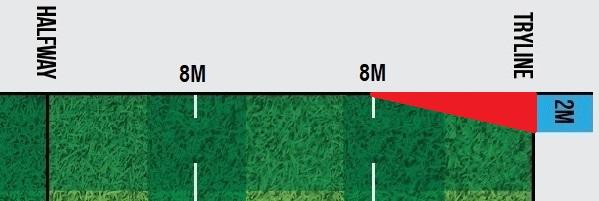 |
| Power Play | In a Power Play situation:
- The attacking team has 7 attacking players on the field and receive a set of 6 tags with a tap kick held to restart play anywhere along the horizontal line 8m out from the defensive teams try line. - The defending team must drop to 5 defensive players for 1 tag. If within that 1st tag the ball is deemed dead or a tag is made, then the 6th defensive player can return to the field.If the ball is knocked on by the defensive team and is recovered by the attacking team the ball is not deemed dead and the defensive player that knocked on must substitute, and the Power Play will continue until a tag is made. |
| Pre-Tag | When a tag is taken off an attacking player before they receive the ball. Pre-Tag is at the referee’s discretion. |
| Professional Foul | A deliberate breach of the rules in order to prevent a scoring opportunity. |
| Promote the ball | An attacking player may run, kick, or pass the ball attempting to get further downfield and score a try. |
| Ranking Score | The amended score achieved through winning the game (Game Score) and where tries are score and conversions kicked. This score contributes to a team’s Overall Score for a round. |
| Restart | (RE Kick-off) The start of play by kick-off following a try being scored, or at half time.(RE Penalty/Changeover) The start of play by tap kick or roll-the-ball following a penalty/changeover being awarded by the referee. |
| Roll-the-Ball | When the ball player rolls or places the ball behind him/her to the dummy half following a tag being made. Three methods can be used to do this:
1. Roll the ball with foot 2. Roll ball backwards with hands 3. Place ball back behind the heel of the closest leg (Place Back) |
| Ruck | The roll-the-ball area consisting of the player rolling the ball, the marker, and the dummy half. |
| Scoring zone / Scoring box | 5 scoring zones exist on/over the try line – left and right corner box (2m wide), center scoring box (4m wide) and the 2 scoring zones between the scoring boxes. Each scoring zone carries a different point structure for a team’s Ranking Score. |
| Send Off | To remove a player from the Field of Play and remainder of the game for misconduct. Red cards be used to signal a send off. |
| Shadowing | Moving alongside/nearby an attacking player until the shadowing player is able to conduct a tag without infringement e.g., being offside. |
| Sideline | The line on either side of the field, outside of which is deemed out of the field of play and the ball is dead. The sideline has an imaginary pane of glass where the ball only need cross i.e. does not need to land on the ground beyond the sideline. |
| Sin-Bin | To remove a player from the Field of Play and for a period of up to 2 minutes for misconduct. The player during the sin-bin is to be located behind the opposition teams’ try line. Yellow cards be used to signal a sin-bin. |
| Six Again (RE Penalty) | A Six Again call allows for greater flow of the game with less stop/start situations due to penalties being given. It means that the attacking team that has had a penalty infringed on then will receive a restart in their tag count (with the first tag being made zero in the tag count) in lieu of a penalty given. |
| Spin | A ball carrier rotating 360 degrees to avoid being tagged. |
| Sub-box | The marked area on the sideline where a team’s substitute players must stand during a game. This is the area between the two 8m lines either side of the halfway line. |
| Substitute players / Sub | Players that are not in the current team playing on the field. These players reside in the sub-box and are available to substitute for a player on the field. |
| Substitution | Substitution is replacing one player with another during a match. This could be for normal replacement (i.e., they are tired) or a forced substitution due to making and error or infringement and a penalty is given (in defence). Note: This is not to be confused with dropping to 6 players when moving from attack to defence as there is no substituting of players. |
| Tag (AKA Tagged) | The removal of the tag/s from the ball carrier belt, shorts, or tights. This includes a tag accidentally falling off or the ball carrier accidentally removing his/her own tag/s. Tags can also be known as flags. |
| Tagging Distance | When a defender is deemed to be close enough to an attacker to be able to remove their tag. Tagging distance is at the referee’s discretion. |
| Tap Kick | A deliberate touch of the ball with the foot taken:
a. to restart play following a penalty, or a changeover. b. if a marker is not present during a roll-the-ball following a tag being made. Note: The ball does not need to be released from the hands in either point a. or point b. above. The ball can be tapped directly from the hands onto the foot. |
| Throw-In | A form of changeover used when the ball crosses the imaginary ‘pane of glass’ of the sideline. Play is restarted by the ball being passed in from the sideline to a teammate within the field of play or the player throwing it to themselves. |
| Try | Grounding the ball on or over the try line. |
| Try line | The line at either end of the field behind which an attacking player must ground the ball to score a try. When kicking or from a loose ball (e.g., a bad pass) the try line has an imaginary pane of glass where the ball only need cross i.e. does not need to land on the ground beyond the try line. |
| Twist | A ball carrier rotating/pivoting their hips clockwise and/or counterclockwise to avoid being tagged. |
| Up and Under Kick | A kick deliberately kicked high. Typically, a kick that goes higher than it does further in distance down the field. Up and Under kick penalties are at the referee’s discretion. |
| Voluntary Tag | When an attacking player either plays the ball with both tags attached or deliberately removes one or both of his/her own tags. |
| Waste Time | Unnecessarily delaying play. This may include taking excessive time to return to the mark and roll-the-ball, or to tap kick in a changeover or penalty. This is also done when the referee count exceeds the 10 second time limit for taking a conversion, returning the ball back to the halfway line to kick-off, or restart play from a kick-off. This is also done when taking longer than 5 seconds restart play following a penalty being awarded. To waste time is at the referee’s discretion. (RE Kick) A kick that is deliberately kicked out over the sideline or try line with the intention of wasting time. |
| X Points | Challenges are set for each round (e.g., score 2 left corner box tries). If a team successfully completes that challenge, they receive X Points. This score contributes to a team’s Overall Score for a round. |